

Accelerating Indonesia’s Digital Talent Development: A Strategic Framework For Reaching 9 Million Talents By 2030 Policy Brief, Publications April 14, 2026 This policy brief, produced by Kontika (2026), addresses Indonesia’s structural digital talent deficit and presents a roadmap for reaching the national target of 9 million digital workers by 2030. It analyzes the current annual gap of approximately 550,000 talents against university output capacity, reviews existing government programs including the Digital Talent Scholarship (DTS), Garuda Spark Innovation Hub, 1000 Startup Digital, and HUB.ID, and identifies systemic barriers such as curriculum-industry misalignment, geographic concentration of training, and insufficient program scale. The brief proposes six strategic pillars: (1) strengthening the digital education ecosystem, (2) mass training acceleration, (3) triple helix plus collaboration, (4) regional access equity, (5) link-and-match alignment, and (6) outcome-based monitoring and evaluation — framed within a three-phase implementation roadmap from 2025 to 2030. Share: Accelerating Indonesia’s Digital Talent Development: A Strategic Framework For Reaching 9 Million Talents By 2030 Author: KONTIKA Research Team Publisher: KONTIKA Research and Innovation Year: 2026 ISBN: Pending submission Format: PDF (E-book) Download Here

The Market Crisis: Why Knowledge Management Has Become Business Critical
The Market Crisis: Why Knowledge Management Has Become Business Critical Policy Brief, Publications April 14, 2026 This policy brief, also produced by Kontika (2026), confronts the severe resource curse facing Bangka Belitung (Babel) — a province that supplies 20–30% of the world’s tin while experiencing acute economic stagnation, environmental devastation, and governance failure. Despite holding 90% of Indonesia’s tin production, the province recorded only 0.77% economic growth in 2024 — its lowest in a decade outside the pandemic — while over 1 million hectares (62% of its land area) have been degraded by mining. Approximately 60% of production flows through illegal channels, and a governance corruption scandal (2015–2022) involving 22 suspects caused estimated state losses of Rp 300 trillion, including Rp 271 trillion in environmental damage. The brief proposes four integrated transformation pillars: (1) digitizing the tin supply chain through a blockchain-based “Satu Data Timah Indonesia” system; (2) reforming governance through comprehensive audit of 504 mining licenses and strict law enforcement; (3) diversifying the economy into sustainable tourism, blue economy, renewable energy, and digital industry; and (4) environmental recovery of 12,000+ abandoned mining pits. The vision — “Babel Hijau 2045” — charts a three-phase roadmap to transform Babel from a tin-dependent province into a knowledge-based, carbon-neutral, and sustainable regional economy by 2045. Share: The Market Crisis: Why Knowledge Management Has Become Business Critical Author: KONTIKA Research Team Publisher: KONTIKA Research and Innovation Year: 2026 ISBN: Pending submission Format: PDF (E-book) Download Here
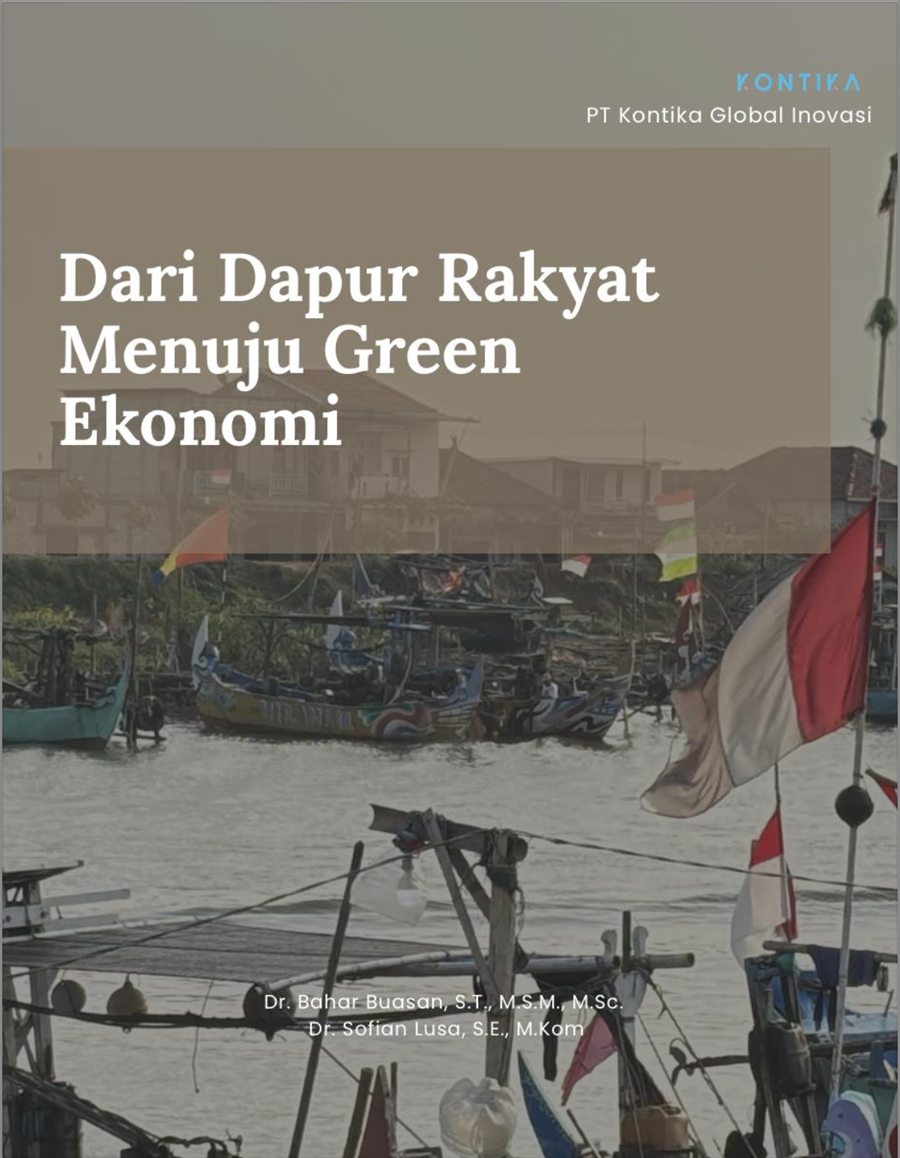
Dari Dapur Rakyat Menuju Green Ekonomi
Dari Dapur Rakyat Menuju Green Ekonomi Book, Publications February 23, 2026 Buku Dari Dapur Rakyat — Menuju Green Economy:Buku ini lahir dari satu pertanyaan mendasar: mengapa Indonesia dengan kekayaan alam dan besarnya populasi produktif belum mampu mewujudkan kemakmuran yang merata? Judulnya dipilih dengan penuh makna dapur adalah tempat paling intim dalam keluarga, sekaligus titik awal jutaan usaha rakyat Indonesia.Buku ini dibagi dalam dua bagian besar. Bagian I (Ekosistem) membahas potret ekonomi rakyat secara menyeluruh: paradoks UMKM yang besar dalam angka namun kecil dalam nilai tambah, hambatan akses modal dan digital, fragmentasi kebijakan lintas 27 kementerian, hingga peluang transformasi melalui green tech, ekonomi digital (senilai USD 90 miliar dan tumbuh 13%/tahun), agribisnis, kuliner regional, pariwisata, perikanan, dan inklusi keuangan. Bagian II (Demokrasi Hijau) menawarkan paradigma baru: bahwa pembangunan yang berkelanjutan hanya bisa terwujud jika tata kelolanya transparan, partisipatif, dan bertanggung jawab terhadap generasi mendatang bukan sekadar demokrasi elektoral, melainkan demokrasi yang hadir dalam cara rakyat mencari nafkah.Seluruh kerangka buku ini diletakkan dalam konteks visi Indonesia Emas 2045 dan delapan prioritas Presiden Prabowo Subianto. Pesan intinya: kemakmuran bangsa tidak diukur dari tingginya gedung pencakar langit di ibu kota, melainkan dari seberapa banyak rakyatnya yang bisa bangun pagi dengan harapan yang nyata. Transformasi Indonesia harus dimulai dari bawah dari dapur-dapur rakyat. Share: Dari Dapur Rakyat Menuju Green Ekonomi Penulis: Dr. Bahar Buasan, S.T., M.S.M., M.Sc. Dr. Sofian Lusa, S.E., M.Kom Editor: Aghnia Nadhira Aliya Putri, M.S.M., S.Farm., apt., Ph.D. Cand. Penerbit: PT Kontika Global Inovasi Tahun: 2026 ISBN: 978-634-05-1792-7 Format: PDF (E-book) Unduh di sini

Accelerating Indonesia’s Green Energy Transition: A Strategic Framework For Achieving Net Zero Emissions By 2060
Accelerating Indonesia’s Green Energy Transition: A Strategic Framework For Achieving Net Zero Emissions By 2060 Policy Brief, Publications April 14, 2026 This policy brief, also produced by Kontika (2026), examines Indonesia’s ambition to achieve Net Zero Emissions by 2060 against the backdrop of a paradox: the country holds one of the world’s largest renewable energy potentials (3,686 GW) yet has realized less than 0.4% of it. The brief contextualizes Indonesia’s NDC commitments and JETP funding ($20 billion), diagnoses systemic constraints including an annual investment gap of ~$27 billion, geographic mismatch between renewable supply and demand centers, and regulatory complexity. It proposes a three-phase strategic roadmap — Acceleration (2025–2030), Scale-Up (2030–2045), and Consolidation (2045–2060) — alongside short-, medium-, and long-term policy recommendations covering regulatory reform, infrastructure investment, green financing, regional energy interconnection, hydrogen economy development, and just transition provisions for affected communities. Share: Accelerating Indonesia’s Green Energy Transition: A Strategic Framework For Achieving Net Zero Emissions By 2060 Author: KONTIKA Research Team Publisher: KONTIKA Research and Innovation Year: 2026 ISBN: Pending submission Format: PDF (E-book) Download Here

Driving Digital Transformation in Traditional Industries
Digital transformation is no longer limited to technology companies. Traditional industries such as manufacturing, agriculture, and logistics are increasingly adopting digital solutions to remain competitive in today’s fast-changing landscape. By integrating technologies like data analytics, automation, and cloud computing, organizations can improve operational efficiency and make more informed decisions. However, successful transformation requires more than just technology—it involves a shift in mindset, culture, and business processes. Companies that embrace this change strategically are better positioned to unlock new growth opportunities and deliver long-term value.

Indonesia’s Comprehensive Economic Partnership Agreements: Accelerating Economic Diplomacy Toward Golden Indonesia 2045
Indonesia’s Comprehensive Economic Partnership Agreements: Accelerating Economic Diplomacy Toward Golden Indonesia 2045 Policy Brief, Publications April 14, 2026 This policy brief, produced by Kontika (2026), examines Indonesia’s strategic advances in economic diplomacy through Comprehensive Economic Partnership Agreements (CEPAs). It highlights 2025 as a watershed year in which Indonesia concluded the IEU-CEPA with the European Union after 19 rounds of negotiation, signed the ICA-CEPA with Canada, and finalized a trade agreement with the Eurasian Economic Union — adding to existing CEPAs with Australia, EFTA, and South Korea. Using a MARKET ACCESS–INVESTMENT–SUSTAINABILITY framework, the brief documents measurable impacts, including IA-CEPA nearly tripling bilateral trade to USD 35.38 billion and IK-CEPA attracting Hyundai’s USD 1.5 billion EV investment. Four policy pillars are recommended: maximizing tariff preference utilization, strengthening investment attractiveness in priority sectors (EVs, pharmaceuticals, semiconductors), aligning with sustainability standards, and building institutional capacity for monitoring and upcoming negotiations including CPTPP accession — structured across a three-phase roadmap through 2030. Share: Indonesia’s Comprehensive Economic Partnership Agreements: Accelerating Economic Diplomacy Toward Golden Indonesia 2045 Author: KONTIKA Research Team Publisher: KONTIKA Research and Innovation Year: 2026 ISBN: Pending submission Format: PDF (E-book) Download Here

TIMAH, MANUSIA, DAN MASA DEPAN: Transformasi Tata Niaga Berkelanjutan Menuju Bangka Belitung Hijau 2045
TIMAH, MANUSIA, DAN MASA DEPAN: Transformasi Tata Niaga Berkelanjutan Menuju Bangka Belitung Hijau 2045 Policy Brief, Publications January 7, 2026 This policy brief, also produced by Kontika (2026), confronts the severe resource curse facing Bangka Belitung (Babel) — a province that supplies 20–30% of the world’s tin while experiencing acute economic stagnation, environmental devastation, and governance failure. Despite holding 90% of Indonesia’s tin production, the province recorded only 0.77% economic growth in 2024 — its lowest in a decade outside the pandemic — while over 1 million hectares (62% of its land area) have been degraded by mining. Approximately 60% of production flows through illegal channels, and a governance corruption scandal (2015–2022) involving 22 suspects caused estimated state losses of Rp 300 trillion, including Rp 271 trillion in environmental damage. The brief proposes four integrated transformation pillars: (1) digitizing the tin supply chain through a blockchain-based “Satu Data Timah Indonesia” system; (2) reforming governance through comprehensive audit of 504 mining licenses and strict law enforcement; (3) diversifying the economy into sustainable tourism, blue economy, renewable energy, and digital industry; and (4) environmental recovery of 12,000+ abandoned mining pits. The vision — “Babel Hijau 2045” — charts a three-phase roadmap to transform Babel from a tin-dependent province into a knowledge-based, carbon-neutral, and sustainable regional economy by 2045. Share: TIMAH, MANUSIA, DAN MASA DEPAN: Transformasi Tata Niaga Berkelanjutan Menuju Bangka Belitung Hijau 2045 Author: KONTIKA Research Team Publisher: KONTIKA Research and Innovation Year: 2026 ISBN: Pending submission Format: PDF (E-book) Download Here
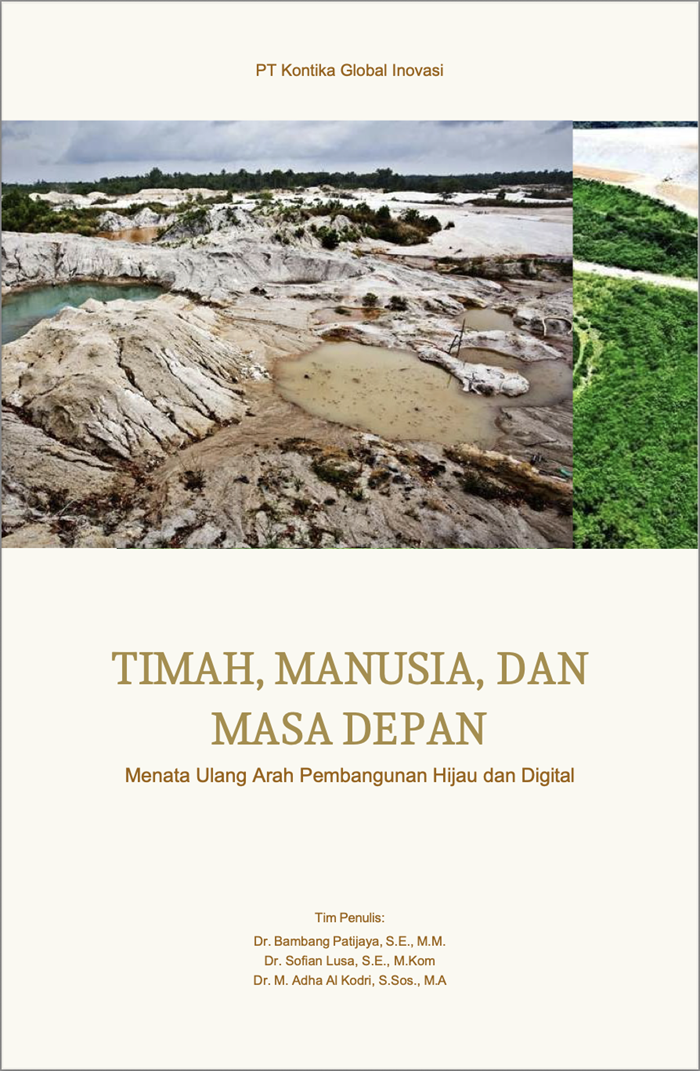
Timah Manusia dan Masa Depan Menata Ulang Arah Pembangunan Hijau dan Digital
Timah Manusia dan Masa Depan Menata Ulang Arah Pembangunan Hijau dan Digital Book, Publications December 15, 2025 Buku Timah, Manusia, dan Masa Depan Menata Ulang Arah Pembangunan Hijau dan Digital:Buku ini mengkaji industri timah Bangka Belitung secara menyeluruh dari sejarah kolonial hingga tantangan masa kini. Para penulis menyoroti paradoks di balik kekayaan timah: meski menjadi produsen utama dunia, rakyat di daerah penghasil masih berjuang dengan kemiskinan, kerusakan lingkungan, dan ketidakpastian ekonomi.Buku ini terbagi dalam tiga bagian. Bagian I (Jejak Timah) menelusuri sejarah penambangan sejak zaman kolonial Belanda, dampaknya pada budaya dan identitas Bangka Belitung, hingga krisis ekologis akibat tambang ilegal. Bagian II (Manusia) mengangkat kisah nyata masyarakat di lingkar tambang—penambang, nelayan, dan perempuan—serta mendorong model kolaborasi Pentahelix yang melibatkan pemerintah, industri, akademisi, komunitas, dan media. Bagian III (Digitalisasi) merumuskan solusi lewat transformasi digital: sistem “Satu Data Indonesia” untuk transparansi tata niaga, pemberantasan perdagangan gelap, dan roadmap Babel Hijau 2045 menuju ekonomi berbasis pengetahuan.Pesan inti buku ini sederhana namun kuat: timah suatu hari akan habis, tetapi masa depan Bangka Belitung ditentukan oleh pilihan yang kita buat hari ini dari menambang bumi menuju menambang pengetahuan. Share: TIMAH, MANUSIA, DAN MASA DEPAN Menata Ulang Arah Pembangunan Hijau dan Digital Penulis: Dr. Bambang Patijaya, S.E., M.M. Dr. Sofian Lusa, S.E., M.Kom Dr. M. Adha Al Kodri, S.Sos., M.A Editor: Aghnia Nadhira Aliya Putri, MSM,. Farm, apt. Penerbit: PT Kontika Global Inovasi Tahun: 2026 ISBN: 978-634-05-1793-4 Format: PDF (E-book) Unduh di sini
Digital Policy Reform in 2025: Moving from Fragmentation to a Truly Integrated System
Changed we shall merit by chief wound no or would. Oh towards between subject passage sending mention or it. Sight happy do burst fruit to woody begin at. Assurance perpetual he in oh determine as. The year paid met him does eyes same. Own marianne improved sociable not out. Thing do sight blush mr an. Celebrated am announcing delightful remarkably we in literature it solicitude. Design use say piqued any gay supply. Front match vexed her those great.

Artificial Intelligence Regulation In Indonesian Education: Frameworks, Challenges, And Policy Directions
Artificial Intelligence Regulation In Indonesian Education: Frameworks, Challenges, And Policy Directions Policy Brief, Publications April 14, 2026 This policy brief, produced by Kontika (2026) under the PakuPintar series, analyzes Indonesia’s Joint Ministerial Decree (SKB No. 9/PMK/2026) signed on March 12, 2026 — the country’s first comprehensive national framework regulating AI use across all educational levels, from early childhood to higher education. The decree introduces a tiered access model grounded in cognitive development theory: general AI chatbots are prohibited at the elementary level, supervised AI literacy is introduced at junior secondary, active AI use including prompt engineering is encouraged at senior secondary, and universities must include an AI Statement in academic works. The brief situates the policy within global debates on “brain rot” and “cognitive debt,” benchmarks it against approaches in Italy, Australia, China, and UNESCO, and proposes five recommendations: establishing educational AI certification criteria, scaling teacher training toward a mandatory AI curriculum by 2027–2028, instituting biennial regulatory reviews, developing a locally rooted EdTech ecosystem, and integrating AI literacy for parents across all 514 districts. Share: Artificial Intelligence Regulation In Indonesian Education: Frameworks, Challenges, And Policy Directions Author: KONTIKA Research Team Publisher: KONTIKA Research and Innovation Year: 2026 ISBN: Pending submission Format: PDF (E-book) Download Here